


Today, of all the errands I needed to do, the one I wanted to do was to stop at the library. It is our little library, in a rather newish section of Hughson with stucco exteriors and too-small parking. But I leave the kids in the car and leave the car running, open up the door to walk the ten feet or so to the counter. “This is a zip book,” I say as one book goes left and the other three go right.
Sophia stops me to let me know someone from the Friends of the Library wants to get a hold of me. We wrangle a little as we’re apt to do as I say she can give them my personal contact info, but she would rather follow the rules. It is a good exchange and one we have regularly, not so much about the contact info as our little differences. We laugh and, I hope, genuinely enjoy the moments that come when one regularly sees the same people from day to day.
My daughter likes to visit the library to visit Sophia. They talk about books they have read, and Sophia listens, smiling, offering her ideas and enthusiastically taking note of my daughter’s recommendations.
Before Sophia, it was Heather. Heather and I discussed old movies, because she watched them with her father. Our bigger connection came through my son, Peter. My older children sat around the carpet to read; I sat down exhausted from the heartache of life, and Heather sat with Peter, doing the crafts with him, watching him progress through his toddler years. Those were defining moments of that time period for me, as those conversations with Sophia will be for my daughter.
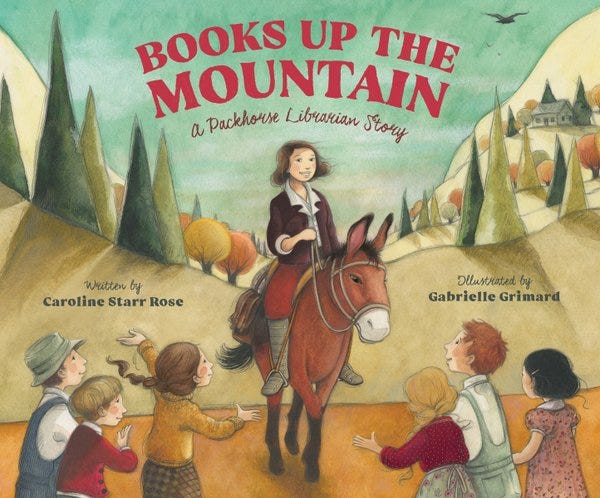
Books up a Mountain: A Packhorse Librarian Story arrived in the mail last week, a bit ahead of its publication date for people like me to review the work. I read picture books first with my children, because their reactions are more telling than mine.
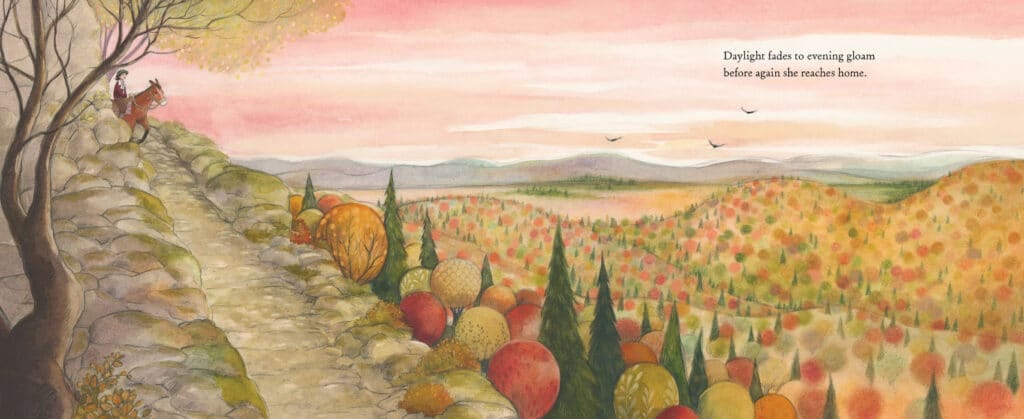
We lingered on the pages of Books up a Mountain written by Caroline Starr Rose and illustrated by Gabrielle Grimard. The illustrations were simple enough: watercolor in earthy tones conveying the naturalness of a landscape so wild it can only be crossed by horse or mule. We see the walls lined with faded newspapers, the period grain sack clothing of the Great Depression, the changing of the seasons. I noticed as we read through this story for the first time how unchanging is the face expression of the unnamed Book Woman of the story. How constant it is, like her effort carrying out the task given to her by the Works Progress Administration, to traverse these mountains to bring books to those remote dwellers far away from the town library.
The Book Woman returns to a different kind of sewing circle where she connects with others like her to mend the books that will go out again.
It is in the final pages of the book where we see her and her steady gaze, looking into the eyes of a man, steadily gazing back. My six-year-old daughter paused and lingered with her eyes, as I also found myself doing.
That gaze, rendered so absorbingly, reminded me of something.
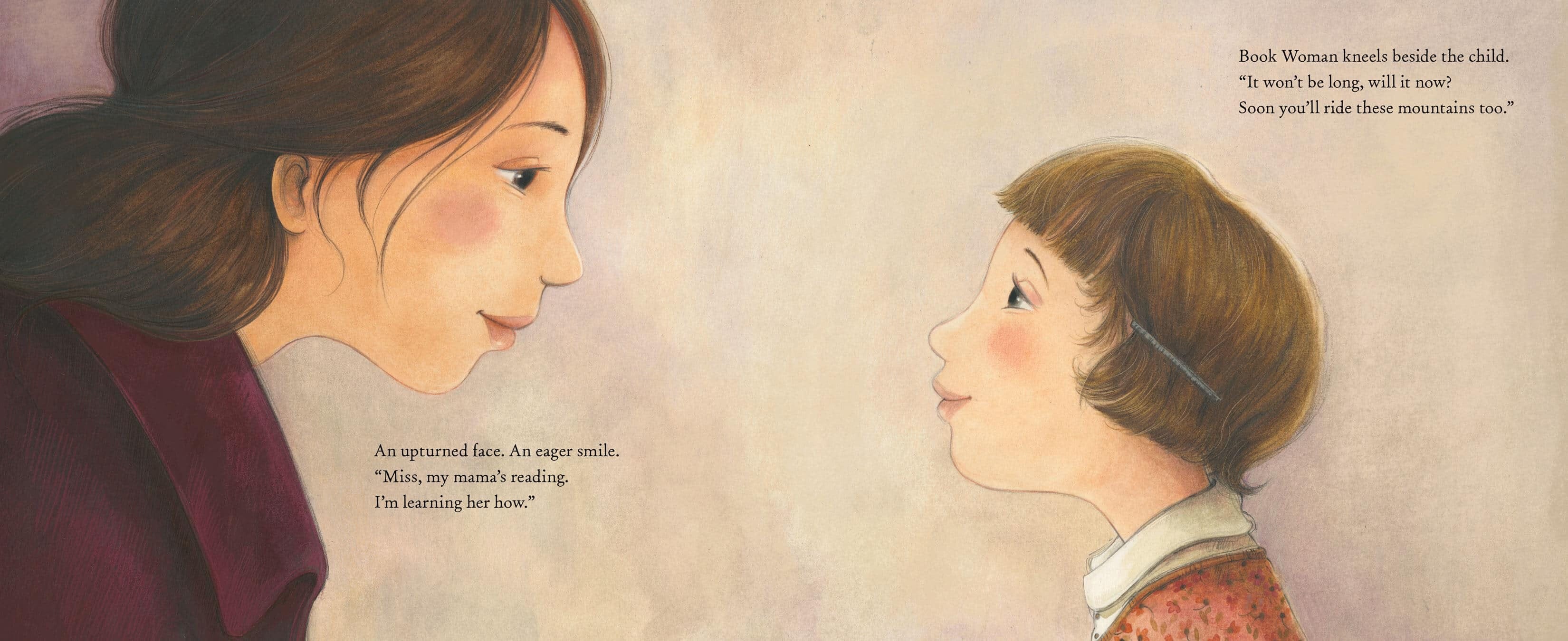
The Book Woman is seeing the whole person. The reader learns through the story and description of this librarian’s work that the Book Woman cares for the whole person. She does more than deliver books. She sets a spell, reading aloud, making book recommendations, sharing the news of neighbors so remote a season will pass before they see each other again.
This is my experience of these libraries, postage stamp in size compared to other libraries nearby, small enough to know the patrons by name and manner. It must be in those slower, though still colorful days of San Francisco that a young Jack London walked into the library to ask for a book recommendation, and Ina Coolbrith offered him one. He came again and again, getting his education from her book recommendations, later becoming one of America’s greatest writers.
It may be the personal nature of the book that we consume with our eyes, digest with our imagination and then share in our discussions later on. Or it is in the small, open-to-anyone spaces with a remarkable number of ways to serve them that makes it so easy to enter and read, or enter and chat, to enter and be seen.
The algorithm can only average its recommendations, putting forward what has drawn the most attention from others. Its book recommendations pale in comparison to the sparkling eyes of a library assistant who has read every book in the series, or the librarian who remembers it best as the last movie she saw with his father, the one he always fell asleep to but insisted he loved.
In More Than Words: Writing in an Age of AI, Jack Warner proposes a sense of community can help us to develop our taste in books, not taste in the sense that “everyone should like this” but rather, “these are the types of books I enjoy, want more of, and often.”
Books up a Mountain: A Packhorse Librarian Story uses that musical, straightforward language one comes to expect from Waxwing Books, which is, undoubtedly, the muster these books must pass to be published by this imprint. It must read aloud well. Even the historical facts at the back of the book were engaging and held us longer, themselves worthy of being read aloud.
I come back to that two-page spread, her eyes meeting his from across the book, across the mountain. As embodied persons, we think and feel with intuition, reading the person before our brains even have time to process what we are perceiving. And then our brains process, adding to the depth and richness of our understanding of one another. When we see one another, we see more than the patterns and mathematical probabilities processed by AI; we see bits and pieces of the soul, as we collect the bits and pieces over time with the people we encounter.
The Appalachia of the Great Depression is remote from my world, but this small town library is not, and in the pages of this, the newest of Waxwing Books and officially coming out August 4, I saw bits of our own life, right there on the page.
Originally published in the Hughson Chronicle & Denair Dispatch on August 4, 2026. The Hughson Chronicle & Denair Dispatch is part of MidValley Publications and is committed to the power of the positive press. Reprinted with Permission.
The Hughson Chronicle & Denair Dispatch is a weekly, print-only local newspaper. To subscribe, call 209–358-5311.