


An Introduction to the Text: Kristin Lavransdatter
“Can you recommend a novel with a strong female protagonist?”
“Yes, Kristin Lavransdatter,” he said, without hesitation.
Okay…the priest went on to give something like a synopsis. I remember nothing of it. Whatever it was could be nothing in comparison to this 1000-page epic of the life of a … housewife.
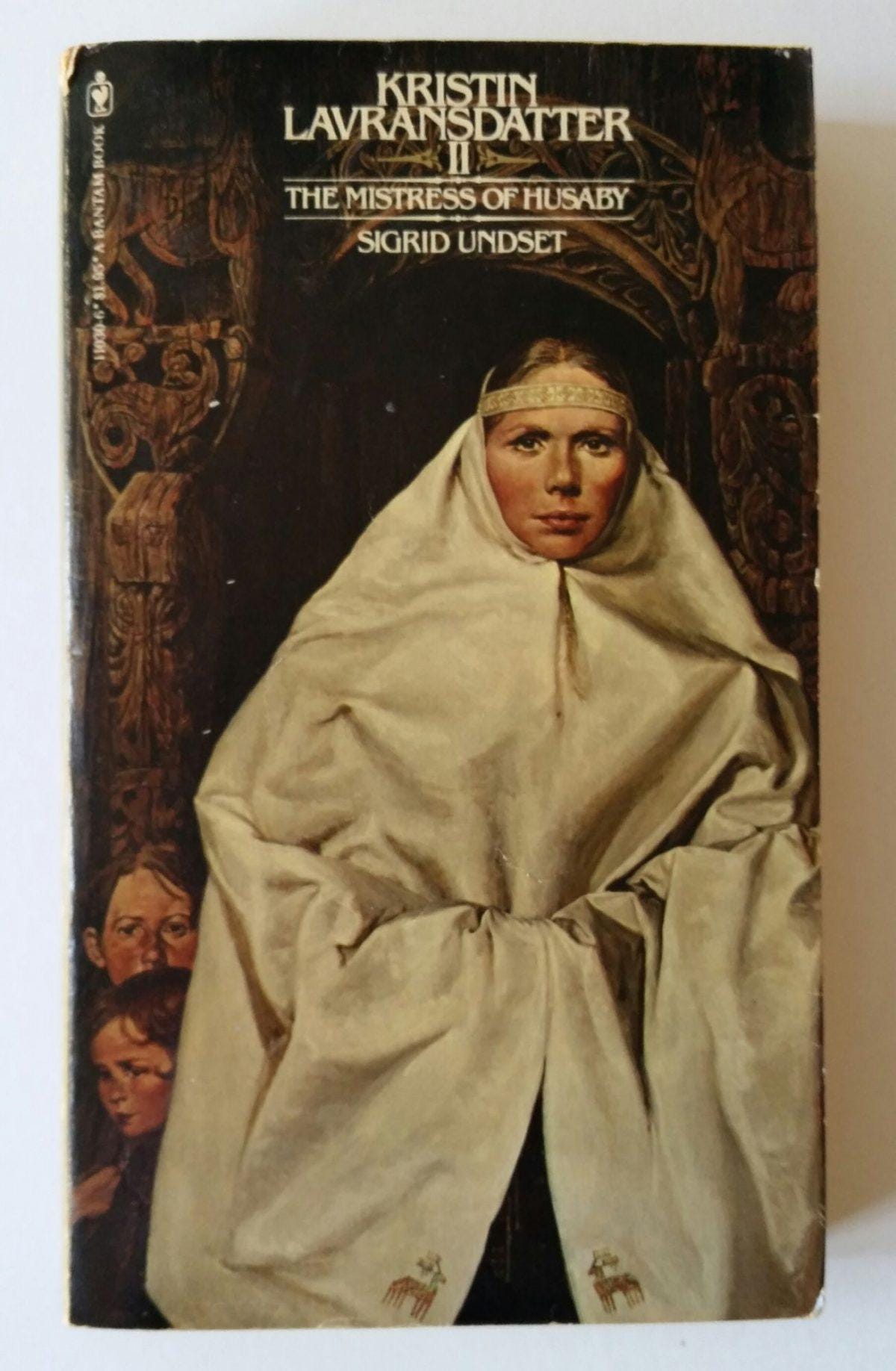
Kristin Lavransdatter, written by Sigrid Undset (1882–1949), was published in Norway as three novels from 1920 to 1922: Kransen (The Wreath), Husfrue (The Wife), and Korset (The Cross). We enter the novel in the happy, carefree childhood of a girl beloved by her father. Her childhood is not without shadows, and as she grows, we will begin to understand, as she does, the images in the shadows, gaining a clearer understanding of what she saw as a child, as she matures into a woman and enters old age.
Kristin lives in 14th-century Norway, a Catholic world still with close ties to the ancient, pre-Christian legends and beliefs. As an older teenager, betrothed to another, Kristin falls madly in love and lust for Erland of Husaby, a Knight, um, arrant, who seems to destroy all he comes in contact with.
We follow Kristin through her untimely pregnancy, her marriage, her early motherhood, her widowhood, through seeing her sons make their way in the world and her death.
Why should a woman’s tale make up most of 1000 pages? The story is not without drama; its plot points read like a soap opera, and its subplots like episode summaries of prestige television. Beyond that, Undset takes us into the mind and heart of her characters. They are fully developed personalities, and their personalities are drawn to one another and clash with one another as life circumstances evolve.
Recall The Powers of Ten by Charles and Ray Eames? If Tolstoy’s War and Peace is the magnificent work that it is because of the broadness of its scope in treating Russia’s history and issues, then Tolstoy is that image that takes us by the powers of ten out into the universe. Undset is the opposite. She takes us deep into the heart and mind, and what a visit. No less magnificent for its smallness, as its details are intricate and intimate, and just as hard to catch the aspects we pass by as we travel through.
I have read Kristin Lavransdatter four times since that first recommendation. As a young woman in love with her boyfriend, as an escape while a young mother in crisis, as a middle-aged mother having suffered in the past but now safe within a rhythm and routine, even peace; and as a woman looking at her older children, marveling at their growth and afraid for their future that lies beyond my reach. All these stages, Kristin experiences too.
At each stage, I felt deeply moved and drawn to new plot points I had overlooked before. The earlier scenes became memories for me that I cherish, but am no longer living.
An Introduction to the Translation
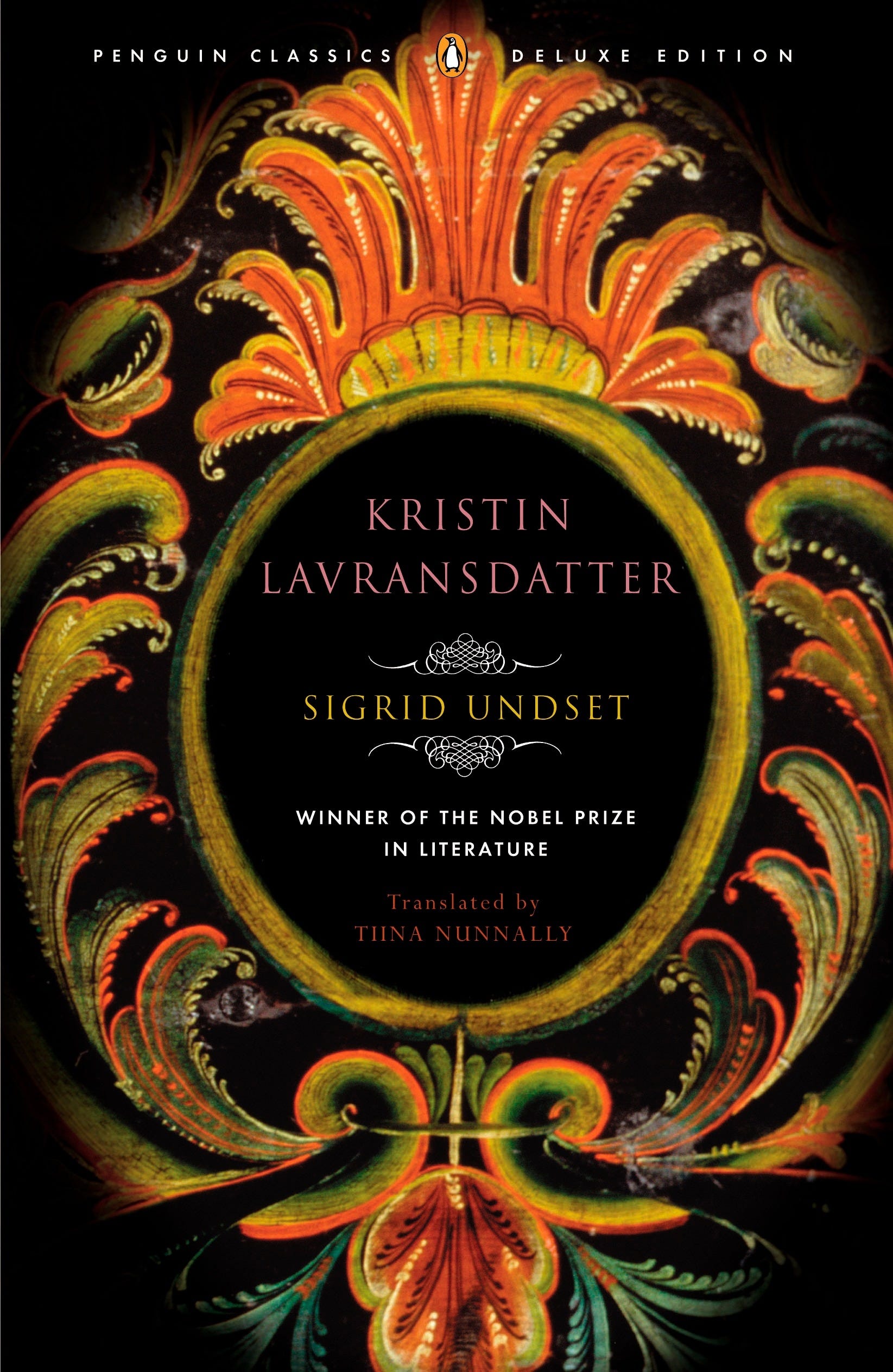
The first English translation, and only English translation until 1997, was by Charles Archer and J. S. Scott, published between 1923 and 1927. Kransen and Husfrue were translated from the original Norwegian as The Bridal Wreath and The Mistress of Husaby.
So much time passed between the first and second reading that I did not give the translation a thought. My first reading was a worn-out paperback borrowed from the Catholic Studies library at the University of St. Thomas in St. Paul, Minn. My second was a brown hardback book checked out, using my husband’s alumni card, from California State University, Stanislaus. I purchased my own vintage copy, from 1946, for my third reading. And when I decided my daughter ought to read this book, I bought the 2005 Penguin Deluxe Edition for my daughter, and after a week, I read it myself.
One more reading took me only partway through the second book, the political events being so difficult to follow.
Since then, I have learned:
Undset was fluent in English.
Undset was alive during the translation and saw the English translation.
Therefore, I assumed, Undset approved of the translation.
So I read her in the early English translations as the original. I enjoyed the otherworldliness of the old language. It took my mind to a different place. Olav Audunssøn, or in the English translation, The Master of Hestviken, is treated similarly. Undset’s modern novels were presented quite differently, direct and poetic, but with an elegant simplicity that characterized early 20th-century literature.
The Tiina Nunnally, modern translation of 1997-2000, is a modernized translation, at least, in comparison to Archer. Nunnally explains the problem with the early translations, “the translators chose to impose and artificially archaic style on the text, which completely misrepresented Undset’s beautifully clear prose. They filled her novels with stilted dialogue (using words such as ‘tis, ‘twas, I trow, thee, thou, hath, and doth), and they insisted on convoluted syntax.”
“Beautifully clear prose”
I recognized to what Nunnally referred.
“Nowadays, the role of the translator is different. Accuracy and faithfulness to the original tone and style are both expected and required,” Nunnally explains before elucidating the patterns of Undset’s prose and style, and the major alterations made by the Archer translation.
Now, as a published author, I have learned:
Publishing a novel is collaborative; editors have opinions, and publishers maintain knowledge of their market.
Authors may not have as much say as we expect from our vantage point a century later.
Undset may have been alive, and she saw the Archer translation, but it wasn’t how she herself chose to write the work.
Comparing goods
Below are three excerpts from each book.
(I learned to compare translations passage-by-passage from welovetranslations.com, a website I highly recommend. Buy the best translations! It makes all the difference.)
“When the lands and goods of Ivar Gjesling, the younger, of Sundbu, were divided after his death in 1306, his lands in Sil of Gudbrandsdal fell to his daughter Ragnfrid and her husband Lavrans Björgulfsön. Up to then they have lived in Lavrans’ manner of Skog at Frollo, near Oslo; but now they moved up to the Jörundgaard at the top of the open lands of Sil” (Archer translation, 3)
When the earthly goods of Ivar Gjesling the Younger of Sundbu were divided up in the year 1306, his property at Sil was given to his daughter Ragnfrid and her husband Lavrans Bjørgulfsøn. Before that time, they had lived at Skog, Lavranss manor in Follo near Oslo, but now they moved to Jørundgaard, high on the slope at Sil (Nunnally translation, 5).
We see it is not drastically different, but there is a difference in poetic quality (doesn’t “earthly goods” have a feeling of finality to it?) and note the use of a language to paint a picture for our imagination (“high on the slope”)
“I have said myself – and other have said the same – that Erlend seems not to be fit for aught else than to beguile women. You are answerable in part for such things being said – to that you have now yourself borne witness. Since then, he has shown that after all he was fit for somewhat else – your husband has won himself a good name for a bold and swift leader in war. ‘Tis no small gain for your sons that their father has wone fame for boldness and skill in arms. That he was – unwise – you should have known best of all of us. Best may you make amends for your shame by honoring and helping the husband yourself have chosen –” (Archer translation, 490)
“I myself have said, and others have said the same, that Erlend doesn’t seem to be capable of much else than seducing women. You are also to blame for this being said, according to your own testimony. But since then he has shown he is capable of other things—your husband has won a good name for himself through courage and swiftness in battle. It’s no small benefit for your sons that their father has acquired a reputation for his boldness and skill with weapons. That he is…incautious…you must realize this better than anyone. It would be best for you to redeem your shame by honoring and helping the husband whom you yourself have chosen” (Nunnally translation, 532)
This passage especially demonstrates the difference in syntax between the translations. One simply just reads better. Nunnally gives other examples in her note on the translation. The prose of the Nunnally translation is cleaner, simpler, and communicates better the thorough dressing down Kristin is receiving in this conversation.
‘Twas now well on in the summer of the year 1349; she had dwelt in the Rein convent two years, and ere Yule-tide came she was to take the veil. And the glad tidings came to her that, for her dedication, both her sons would come out thither in Abbot Johannes’ train. (Trans. Archer, p. 1011)
It was late in the summer of A.D. 1349, she had been at Rein Convent for two years, and she was to take the vows of a nun before Christmas. She received the joyous message that both her sons would come to her ordination as part of Abbot Johannes’s entourage (Nunnally translation, p. 1092).
This line stood out to me in my last read. “It was late in the summer of A.D. 1349.” I know the rest of the story. I don’t feel Undset’s writing has ever required me to grasp Norwegian history to enjoy her works. But Tolstoy and Hugo expect us to grasp something of Russian and French history to keep pace in their novels. After enough of them, it occurred to me, this line probably reveals the intensity of the drama that is to come, if you know what A.D. 1349 is the start of.
Per Wikipedia, “the Black Death reached Bergen in Norway by ship from England in late summer (probably August) of 1349, and spread from Bergen North to Trondheim in the autumn of 1349.”
The tranquility Undset creates leading up to this line, the gentle expression, “It was late in the summer of A.D. 1349,” is masterful storytelling, because it’s all about to fall apart in a dramatic, stormy ending to the 1000 pages of life we have lived with this character. The Archer translation is fine, but the quiet simplicity of Nunnally here is better.
What’s more, I look back, and I have four reading experiences to compare.
The first time, as my boyfriend and I rode bikes through Dry Creek in Modesto, I told him scene after scene from The Wreath, like I was sharing the best gossip or television drama.
And then, surprisingly, I found myself doing the same as The Cross. It cried out to be shared; so much did it fill my imagination.
So there you have it. If you are a book collector and nerd out about publication history like I do, buy the Archer, but read Nunnally. And if you are just looking for a good read, read the Nunnally.
I have loved them both, but find the way the new translation gripped me (and not cheaply, but by filling the imagination with images, concern and emotion) reveals something about its quality.
Now once again, but with temperaments
You can read this book with a book on the temperaments and spend a couple of thousand words analyzing their temperaments and how they interact with one another:
Kristin: Choleric-melancholic
Erlend: Sanguine-phlegmatic
Simon: Sanguine-melancholic
Lavrans: Melancholic-choleric
Ragnfrid: Melancholic-phlegmatic
Try it, it’s fun!
A look ahead:
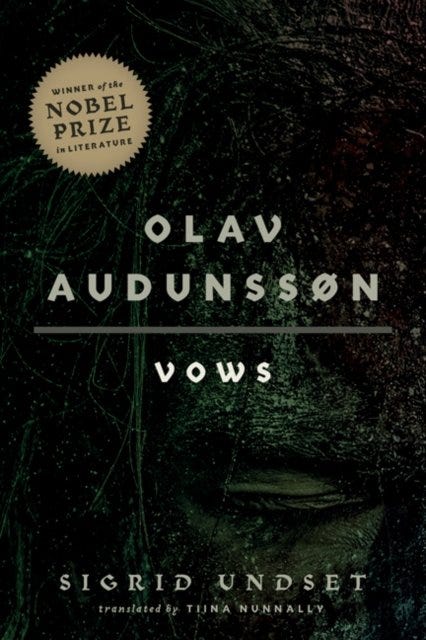
I read The Master of Hestviken (Archer translation) 1.5 times. The first time: fascinating, very exciting to see what happens next. The second time: snooze-fest. And the characters irritated me. I couldn’t make it farther in that reading, even though I know the final book is so exciting.
Could Nunnally do for the second book of Olav (aka “Olav broods”) what she did for the second book of Kristin (aka “our medieval Norway history lesson”)?
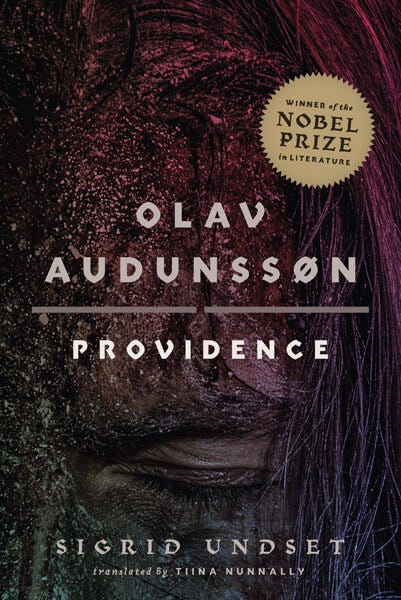
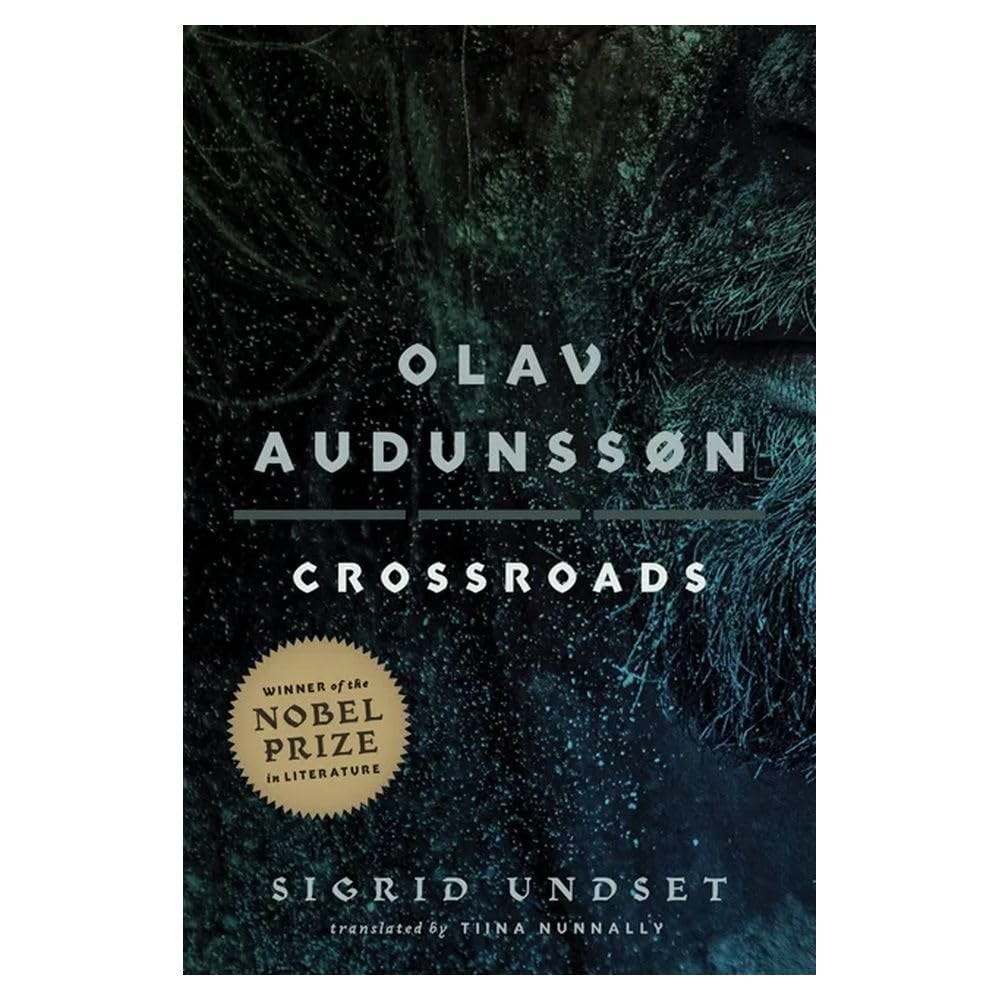
I checked online again and found that three years ago, Nunnally completed her translation of Olav Audunssøn, published by the University of Minnesota Press. I’ll let you know how it turns out!

Also on my reading list
War and Peace by Leo Tolstoy, Trans. Maude. Everyman’s Library
Salvation is from the Jews by Roy H. Schoeman. Ignatius Press.
Magnifica Humanitas by Pope Leo XIV, Vatican.va
Woven Words, an anthology of short poems featuring the work of Stanislaus County youth poets