


As a member of the Ceres American Legion Auxiliary, Margaret Dewitt was a regular attendee at events held by the American Legion Post 872. Born on March 22, 1945, she lived through some of the country’s most pivotal moments. A breakfast on October 1, 2022, gave this reporter the opportunity to hear her story. On the 250th Anniversary, I give you the life of Margaret Dewitt, a down-to-earth example of an American hero.
Dewitt’s mother married after the First World War and worked with the Red Cross during the Second World War, even though he was married. She was 42 when Dewitt was born. Her father, a soldier in World War I, was sprayed with mustard gas and shot in 1917 or 1918. Her brother was a colonel in the US Army.
Margaret Dewitt knew she wanted to join the service after graduating from high school in 1963. “It was kind of scary for girls at that time,” Dewitt said. “Most mothers who didn’t even want their sons in it.”
She married early. Her husband, who was born an illegitimate child of “the master” when his mother worked as a maid in West Memphis, was already serving in the Navy when she married him. He was stationed in Japan. When he went down to the Mekong Delta, he served on USS Saratoga in the Delta.
Nursing in Japan During the Vietnam War
Dewitt worked for the Department of Defense as a civilian nurse in Yokohama.
Why did she work for the Army while he was in the Navy, her husband asked her.
The bulk of Dewitt’s family served in the army. It was the first branch of the military to allow blacks to join. She added, “The Navy turned me down to work because they didn’t really have any casualties. The army had the most.” Dewitt said. 58,000 U.S. Military casualties. “It was a lot of American dead either way.”
Nursing work with the army was “critical,” and Dewitt was glad to do it. “I was only 22. It scared the hell out of me when I saw these big, dead kids I met.”
While she was there, Americans ran the Japanese hospital. Their mission was to stabilize soldiers enough to send them home across the Pacific, where they would enter Travis Hospital and be sent on to hospitals nearer their homes. There were 1200 beds in the 12-story hospital. Dewitt’s bay cared for 86 patients.
“I was a young nurse in my first job, my first big job,” Dewitt said. “The majority of them lived long enough to bring them out, but those that weren’t, they sent for the families to come and visit with them before they died.”
When Dewitt first arrived, it took time to arrange her clearances, giving her the opportunity to experience some of the things provided for servicemen and women in Japan, like concerts with Tony Bennet and other performers. Dewitt directed the wives’ activities. She organized trips to smaller villages, shopping, “girl stuff,” and visiting sights in Japan that she might otherwise have missed. Dewitt took classes in doll making, making replicas of famous geishas, photography, ceramics, and Ikebana flowering arranging.
They lived on base, “because now the wars were going on, and there were so many dependents, you couldn’t get housing.”
She was cleared to work, and at age 23, Dewitt was a GS9.
When they called her, Dewitt traveled from Yokohama to the base where large Japanese-owned barracks had been converted into a hospital. The deafening sound of helicopters landing on the roof and people getting patients terrified them.
Dewitt kept at her work, recalling the most terrifying parts of her experience. She recalled the fear the nurses felt the day when Americans wanted to bring in nuclear-powered ships, and a protest followed. Japanese citizens surrounded the gate. The nurses could not leave the hospital until the unrest was quelled.
Berkeley Protests Against the Vietnam War
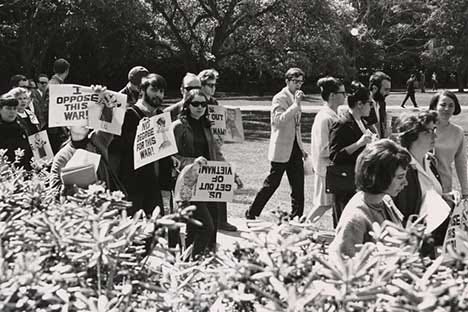
After her service in Japan, Dewitt returned to her home in Berkeley to finish her degree. It was the time of the Vietnam protests. The message was that Americans should not have gone to Vietnam.
“I kind of agreed with them,” Dewitt said, but felt compelled to speak up for the war. “I couldn’t say that. I had to say, well, you know, we’re trying to protect our troops, and help the Vietnamese people.”
But she felt silenced from sharing her experience. “I had to shut up because they were protesting that we’re there. I wasn’t telling all of them I was there, and that I did this, and what was going on. A lot of the secrets and how badly these young kids, 18 to 19 years old, were being blown apart? I saw them when they were hit with fire, how they shot, and they were burned and dead. I saw the effects of it, and it really hurt me because there were a lot of boys, and my family was all in the army.”
Nursing Work and Racism in the Prisons
Worked as a nurse in the prison. She noted she had “a special in my heart, a special feeling for those who had been on the front line and came back and were arrested for drug dealing. She thought especially of those Vietnam veterans who committed crimes, remembering the boys she saw in the hospital, sympathizing with the pain, killing and emotional numbing of drug abuse.
Reluctantly, Dewitt said, “Blacks don’t always have the choice to get better jobs. So you kind of have to take what you can get.”
The medical care was poor in the hospitals. Dewitt said prisoners were “dying by the day from various conditions, and such poor medical care was provided.”
Not many black nurses worked in the prisons, even though blacks make up over half of prison inmates in the United States. Dewitt saw many nurses, married to men who worked in the prison system. “They get so callous, and the women then begin to get that way.”
Dewitt moved on to a county hospital and earned her second degree at Sonoma State, becoming a nurse practitioner. But her timing was off. Professionally, hospitals needed more RNs. Graduates stayed local, creating more competition. “There wasn’t a whole lot of work for the nurse practitioners.”
But a need for Public Health Nurses arose.
The HIV Epidemic
“None of the nurses wanted to do it. Some of ours resigned, so they would not have to take those patients.” Dewitt signed up. “I was so scared of AIDS patients,” she admitted.
Dewitt was sorry to be like the nurses who were afraid and quit. She had lived in New York and Brooklyn, working in a county hospital there. She had seen the toll it takes. The photographs she first saw of AIDS patients came from the East Coast in New York and other major cities like San Francisco. Stanislaus County did not have as many patients, but she became second-in-command for the supervision of Stanislaus County.
“And it turned out that I love them, and I couldn’t believe that.”
The work was primarily case management to make sure they have the health services, hospice and that they keep their appointments.
On her caseload were many single mothers with full-blown AIDS who passed it to their children. Because of her 13 years as a labor and delivery nurse and time in the Vietnam War, supervisors assigned her to work with the mothers. “I managed to make sure they got the services that they got, and it was heartbreaking when the women died because they had kids.”
She said it was different for the men, so many of whom may have left their wives decades before, whose kids did not even know they were gay. But the women knew. Dewitt recalled these women having to turn their children over to their mothers to be raised.
“So after they died, then you just close the case because what else are you going to do?”
Dewitt managed the cases of 35 women.
After working with AIDS patients, Dewitt returned to the County Public Health Department to complete her nurse practitioner practicums, then to the VA clinic.
Because of her race, she struggled to find a doctor who would sponsor her. Like her, many other women had to relocate to find a doctor under whom they could work. Dewitt found one in Stinson Beach in Marin County at a small clinic on the other side of the coastal mountain range in sight of the Golden Gate Bridge, serving mostly “hippies,” “beach boys,” and “gay people.”
The work was light. Dewitt kept her house in Berkeley, where her sister lived and traveled back and forth to visit.
She returned to Berkeley in 1989 and recalled how crowded it was, with so many poor people.
Dewitt worked for seven years at the County Hospital.
The Red Cross and Widowhood
Dewitt joined the Red Cross in Alameda and transferred to Stanislaus County to work in local shelters. When Hurricane Katrina hit, she was ready for action, but plans changed when her husband was diagnosed with lung cancer. They gave him six months to live.
Dewitt cared for him as she could and then placed him in a hospital in Memphis, where family was nearby who could take care of him. She planned to retire on January 31 and join him.
He died on January 6, 2006. His sister was with him when he died. He is buried in the National Cemetery.
That March, Dewitt turned 60. She needed money but expected to be hard-pressed to find work at her age. A federal mandate changed that, taking over the medical care of prison inmates. 3,200 men lived in the nearby prison. Dewitt had work to do.
The American Legion Auxiliary
During and after her nursing career, Dewitt’s volunteer work with the Auxiliary remained an important part of her life. During Desert Storm, the Auxiliary packed boxes. They sent boxes to Afghanistan. They sent toys to children from military families at Christmas. They hosted big picnics on the 4th of July, outdoor Thanksgiving dinners, Christmas parties, and sent youth to Girls State in Sacramento, where the girls learned about US governance.
“For three days, and they learn about the people who help make America what it is,” Dewitt said.
During my one hour with Margaret Dewitt, I feel I can say the same.